

Patients Already on the Knee Replacement Waiting List Find Platelet-Rich Plasma Outperformed Cortisone and NSAIDS
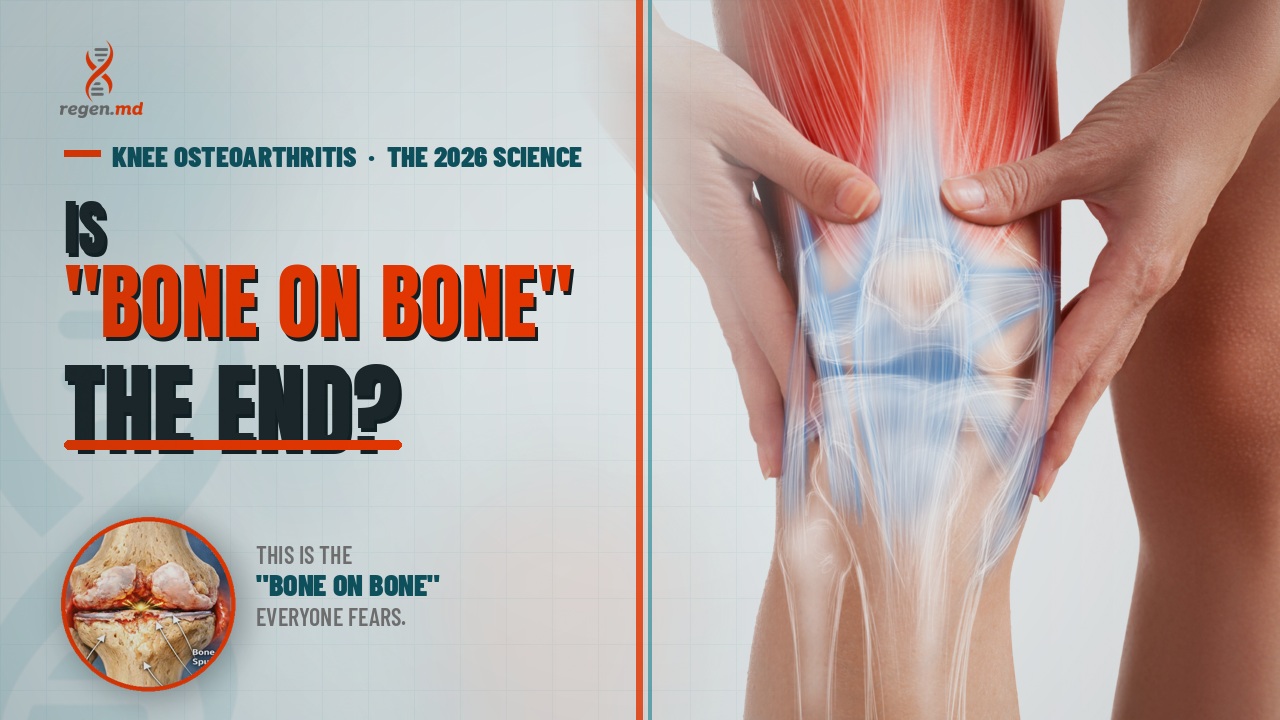
Bone on bone is not the end.

Regen.MD
Patients with "bone-on-bone" arthritis, PRP produced sustained pain and function and measurable shifts in cartilage breakdown.
A knee replacement is a wonderful operation, but it is major, irreversible surgery with a finite lifespan, and the younger you have it, the more likely you are to outlive it.”
ST. LOUIS, MO, UNITED STATES, July 19, 2026 /EINPresswire.com/ -- Randomized Trial in Patients Already on the Knee Replacement Waiting List Finds Platelet-Rich Plasma Outperformed — Gurpreet Singh Padda, MD
Cortisone and Anti-Inflammatories — Including in Blood Chemistry
In 90 patients with "bone-on-bone" arthritis, PRP produced sustained pain and function gains at six months, lower opioid use, and measurable shifts in cartilage breakdown and inflammatory biomarkers. St. Louis physician Gurpreet Padda, MD: "We are not regrowing your cartilage — and the honest version is still the better story."
A randomized controlled trial accepted for publication in the Journal of Orthopedic Surgery and Research has reported that two injections of autologous platelet-rich plasma (PRP) outperformed both corticosteroid injection and oral anti-inflammatory medication in patients with late-stage knee osteoarthritis — and did so not only on pain and function scores, but on serum markers of inflammation and cartilage breakdown.
The trial is notable for who it enrolled. All 90 participants had Kellgren-Lawrence grade 3 or 4 disease — the radiographic stages routinely described to patients as "bone-on-bone" — and all were already on the waiting list for total knee replacement. This is the population most biologic injection trials exclude.
Gurpreet Padda, MD, MBA, who directs the regenerative and metabolic medicine practice, Regen.MD in St. Louis has built patient and physician education around the findings.
"There's a sentence said in exam rooms every day: you're bone on bone, there's nothing left to do, we just have to replace it," said Dr. Padda. "That sentence is a lie — not a malicious one. Most of the doctors who say it genuinely believe it. But it's built on a way of thinking about the body that is decades out of date, and the data directly contradict that way of thinking. These were not easy early cases. These were the patients everyone had already given up on, sitting on a surgical waiting list."
What the Trial Found
Lacko and colleagues at P. J. Šafárik University and L. Pasteur University Hospital in Košice, Slovakia, enrolled 90 patients aged 40 to 80 between September 2024 and June 2025, randomizing them to three arms: two intra-articular injections of non-activated autologous PRP one week apart; a single intra-articular betamethasone (corticosteroid) injection; or oral aceclofenac, an NSAID. Patients were followed for six months, with clinical scores and a 13-marker serum biomarker panel measured at baseline, three months, and six months. Eighty-two patients completed follow-up.
Pain. Visual analog scale scores fell significantly only in the PRP group, from 6.2 at baseline to 3.3 at three months, holding at 3.7 at six months. The corticosteroid group moved from 6.3 to 5.8, and the NSAID group from 6.3 to 5.8 — neither a statistically significant change from baseline. Between-group differences favored PRP at three months (p<0.001 versus both controls) and six months (p=0.004 versus corticosteroid; p=0.002 versus NSAID).
Function and stiffness. Total WOMAC scores improved only in the PRP arm, from 49.0 to 28.1 at three months and 32.5 at six months, with significant gains across pain, stiffness, and function subscales. Corticosteroid scores were essentially unchanged at 45.6, and the NSAID group deteriorated, from 48.8 at baseline to 57.9 at six months.
Opioid use. Rescue opioid consumption, standardized to morphine milligram equivalents, was lowest in the PRP group — significantly lower than corticosteroid at both three months (p=0.002) and six months (p=0.006), and lower than NSAID at three months (p=0.025).
Dropouts. No patient in the PRP arm withdrew. Two corticosteroid patients and four NSAID patients discontinued after three months because their pain was never adequately controlled, and proceeded to earlier total knee replacement. Two additional NSAID patients were withdrawn after worsening ischemic heart disease.
Biomarkers. Compared with the corticosteroid group at three months, PRP patients showed significant reductions in the cartilage-turnover and inflammatory markers COMP (p=0.015), MMP-3 (p=0.024), IL-6 (p=0.035), IL-18 (p=0.037), and TNF-α (p=0.017), alongside increases in the anti-inflammatory and anabolic markers sTREM2 (p=0.019), sRAGE (p=0.017), and TGF-β1 (p=0.048). CGRP — a neuropeptide associated with peripheral pain sensitization — was significantly lower in the PRP group than in both controls (p=0.032 and p=0.024). Reductions in COMP, IL-6, and IL-18 were still present at six months.
Safety. Three PRP patients experienced transient knee pain and swelling that resolved within one day. No other adverse events were recorded in the PRP arm.
The authors' stated conclusion is that PRP is supported as "a safe bridge therapy before arthroplasty."
The Line Regen.MD Insists On
Dr. Padda's educational materials make one limitation non-negotiable.
"We are not regrowing your cartilage. The gap on your X-ray is not going to close," Dr. Padda said. "PRP is not a magic serum that reverses structural damage, and anyone promising you a brand-new joint from an injection is selling a fantasy that will cost you money and hope. The RESTORE trial in JAMA showed that in milder osteoarthritis, PRP did not regrow cartilage or beat placebo in terms of structure. That finding is real, and I respect it. How do I hold both truths? Pain and structure are decoupled. We are not changing the architecture of the knee. We are changing its biology — and in advanced disease, that biological change is what produced measured relief. I would rather tell you a smaller true thing than a bigger false one."
What the Trial Does Not Establish
Regen.MD's materials present the study's limitations alongside its results. The investigators state that participants were not blinded to their assigned intervention; that the three arms differed in route of administration, dosing frequency, and overall treatment intensity, which limits direct comparability; and that the PRP product was not quantitatively characterized in this trial. It was a single-center study. The NSAID arm had a substantial dropout rate due to adverse effects and inadequate pain control. Biomarker analyses were exploratory, and no correction for multiple comparisons was applied.
No structural imaging endpoint was assessed, and the trial makes no claim of cartilage regrowth. It also did not measure how many patients ultimately avoided or deferred surgery — the only surgical events recorded were the six control-arm patients who proceeded to earlier replacement.
Converging Evidence on Treating the Bone Itself
A second randomized controlled trial, published in the Journal of Clinical Medicine in November 2025, addressed a related question in the same severity range. Sánchez Santiuste and colleagues randomized 86 patients with Kellgren-Lawrence grade III–IV knee osteoarthritis in a double-blind multicenter design. All patients received intra-articular Plasma Rich in Growth Factors; the arms differed by whether they also received an intraosseous infiltration into the subchondral bone, or an intraosseous saline placebo.
The intraosseous group improved significantly more across nearly all domains at 3, 6, and 12 months, with 66.7% reaching minimum clinically important improvement in pain versus 46.3% (p=0.0038). No serious adverse events occurred. That trial likewise assessed no structural imaging, and PRGF is a specific leukocyte-poor preparation whose results do not automatically transfer to other platelet systems.
"The objection to biologics in advanced arthritis was always anatomical, and it sounded reasonable: there's no cartilage left, so what are you signaling to," Dr. Padda said. "But in an end-stage knee, the subchondral bone is not inert scaffolding. It's edematous, hypervascular, densely innervated, and remodeling badly, and it generates a substantial share of the pain. Treating only the joint space in a grade IV knee means treating the one compartment where the disease has already finished its work."
Regen.MD performs both intra-articular and intraosseous PRP.
Service Availability at Regen.MD
The practice's orthobiologics program provides image-guided biologic procedures, including intra-articular and tendon PRP in leukocyte-poor and leukocyte-rich preparations, intraosseous/subchondral PRP, bone marrow aspirate concentrate (BMAC), adipose-derived Lipogems grafts, and intradiscal orthobiologics. Every needle is placed under ultrasound or fluoroscopic guidance rather than by anatomical landmark, and diagnostic blocks are used to confirm the pain generator before a biologic is deployed.
The practice's published indication for subchondral treatment is the joint that still hurts after a technically correct intra-articular injection. As its service materials put it, MRI bone-marrow lesions — edema in the subchondral bone beneath a worn surface — track closely with pain and progression, "and a joint-space injection never reaches them." Under fluoroscopic guidance, platelet concentrate is delivered through the cortex into the subchondral bone itself, typically paired with an intra-articular dose — the same combination tested in the Sánchez Santiuste trial.
Regen.MD's published protocol emphasizes matching the preparation to the tissue — leukocyte-rich for tendon, leukocyte-poor for intra-articular and subchondral use — and treating the injectate as a biological drug prepared to a measured therapeutic threshold. The practice's stated position is that "PRP is not one product, and most failures start here," and that "a perfect biologic in the wrong tissue plane is an expensive placebo."
Procedures are paired with the practice's work in metabolic inflammation and its laboratory-guided peptide therapy program, on the rationale that a repair signal delivered into an inflamed, insulin-resistant environment is unlikely to hold. The practice treats chronic back pain, joint dysfunction, metabolic inflammation, and neuropathic pain, and describes its diagnostic sequence in Our Approach.
Regen.MD's joint dysfunction materials note that many patients carrying the bone-on-bone label retain more functional cartilage than the term implies, that radiographic narrowing correlates only loosely with reported pain, and that roughly one in five knee replacement patients reports persistent pain after surgery. Related patient education is available in The Library, including "Bone on Bone Knee?" Why "Nothing Can Be Done" Is a Lie: Is Meniscus Surgery Worth It? What 10-Year Data Reveals, Orthobiologics in St. Louis: Repairing the System Instead of Silencing the Alarm, and Intradiscal PRP: The Protocol for Treating the Disc as Biology, Not Hardware. Further material appears in the Surgery Alternatives and Regenerative Treatments collections and under Patient Resources.
How to Begin
Regen.MD does not offer free consultations or introductory calls. Patients begin with a Clinical Evaluation — a structured diagnostic assessment that includes imaging review, ultrasound examination, and metabolic laboratory work — with a $400 non-refundable fee, initiated through the clinical application at regen.md.
"Come and get a real evaluation," Dr. Padda said. "Let us look at your knee and your biology and tell you honestly whether you're a candidate for a regenerative bridge, or whether replacement really is your best next step. Either way, you finally have the truth and a choice. A knee replacement is a wonderful operation, but it is major, irreversible surgery with a finite lifespan, and the younger you have it, the more likely you are to outlive it. What the data offers is control of the timeline — the ability to decide when, or whether. A bridge isn't a smaller thing than a miracle. Sometimes it's the whole thing."
About Regen.MD
Regen.MD is a regenerative and metabolic medicine practice in St. Louis, Missouri, led by Gurpreet Padda, MD, MBA, who has worked for three decades at the intersection of interventional pain management, regenerative medicine, and metabolic biology. The practice treats chronic back pain, joint dysfunction, metabolic inflammation, and neuropathic pain through image-guided orthobiologic procedures — including intra-articular and intraosseous PRP — alongside laboratory-guided peptide protocols and metabolic optimization. Regen.MD is located at 4477 Woodson Rd, Suite 103, St. Louis, MO 63134, near St. Louis Lambert International Airport.
Gurpreet Singh Padda, MD
Regen.MD
+1 314-668-1525
email us here
Visit us on social media:
YouTube
The Lie of the End of the Road: Bone on Bone
Legal Disclaimer:
EIN Presswire provides this news content "as is" without warranty of any kind. We do not accept any responsibility or liability for the accuracy, content, images, videos, licenses, completeness, legality, or reliability of the information contained in this article. If you have any complaints or copyright issues related to this article, kindly contact the author above.
